
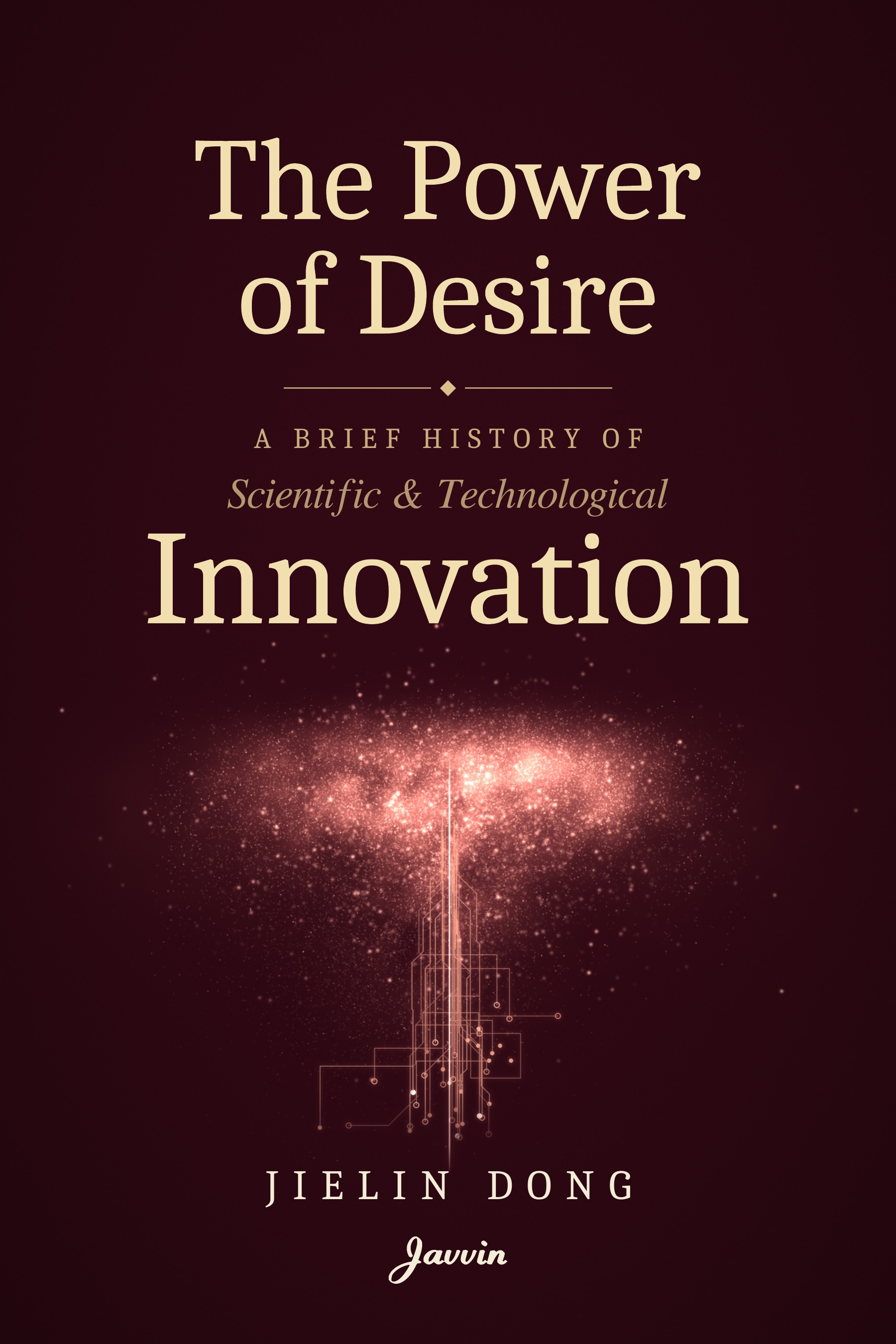
by Jielin Dong · Javvin Company
$12.99
Buy the English Ebook · $12.99Read a free sample (PDF, 19 pages)
PDF ebook · English · 484 pages (incl. cover) · ISBN: 978-1-60267-031-0
License — For one reader, on your own devices. See the License Terms.
Why do humans innovate? From three meals a day and shelter against the cold to travel, entertainment, and the exploration of the unknown, desire has ceaselessly given birth to new technologies — and quietly changed the course of history. The Power of Desire: A Brief History of Scientific & Technological Innovation draws on a database of major scientific and technological firsts to trace, along the thread of human needs, the development of agriculture, medicine, transportation, materials, energy, computing, and artificial intelligence. It compares the character of innovation across regions and eras, and explores the natural, cultural, economic, and institutional forces behind it.
The book attends both to the breakthroughs that changed entire eras and to the power of countless small innovations in kitchens, fields, and workshops: How did agriculture become a trap that later generations could not escape? How did eating habits shape power technologies? How did greed, love, and conspiracy drive the spread of knowledge? This edition updates the database and charts, incorporates new developments such as large language models and robotics, and offers bold predictions on AI's restructuring of manufacturing and service supply chains, U.S.–China technological competition, and innovation trends amid demographic change. This is a work that begins with the wishes of ordinary people, toward understanding how technology writes history — and creates the future.
“Elegant prose, compelling stories, and rigorous analysis—an achievement that invites comparison with Sapiens.”
— Xue Lan, Dean of Schwarzman College, Tsinghua University
“The history of technological invention from the perspective of those who use technology, making it feel tangible and refreshingly new.”
— Sun Xiaochun, Professor, University of Chinese Academy of Sciences
“Vivid, accessible language and stories rooted in everyday life ... showing how the world we live in came to be—and who brought it into being.”
— Zhiwu Chen, Chair Professor of Finance, The University of Hong Kong
“The quiet voices in the long tail of the spectrum of ideas become especially precious, because the future holds countless possibilities.”
— Yan Yan, Founding Managing Partner, SAIF Partners
“Dong weaves human needs into the historical warp and data analysis into the logical weft to examine how science and technology have shaped human history.”
— Guosheng Wu, Chair, Department of the History of Science, Tsinghua University
“Through quantitative analysis and exceptionally well-grounded arguments, the book offers illuminating answers.”
— Weigang Wan, Science Writer
Dr. Jielin Dong is a scholar and commentator whose work spans the history of science and technology, innovation policy, and global technology competition. She is a regular contributor to the Chinese editions of The Wall Street Journal and the Financial Times. She has published numerous articles and five books.
Dr. Dong has held academic and research appointments at Tsinghua University and Soochow University. At Tsinghua, she has served as a part-time research fellow at the China Institute for Science and Technology Policy and as a part-time professor and academic committee member at the Research Center for Technological Innovation. At Soochow, she has served as a distinguished professor and director of the Center for Enterprise Innovation and Development. Her career also includes management roles at technology companies, including Lucent, Cisco, and Network Associates, as well as positions in financial services and scientific research institutes. She has served on the boards of several technology startups.
Dr. Dong earned her Ph.D. in physics from Carnegie Mellon University in 1988 and her B.S. from Sun Yat-sen University in 1982. She went to the United States for graduate study through the highly competitive CUSPEA program.